In-House Fabrication vs Outsourced Contract Manufacturing vs Toll Fabrication Make-vs-Buy Decision Matrix for Pressure Vessel, Heat Exchanger, and Storage Tank Production: CFO + COO Decision Guide for Capital Investment, Capacity, and Risk Allocation
In-House Fabrication vs Outsourced Contract Manufacturing vs Toll Fabrication Make-vs-Buy Decision Matrix for Pressure Vessel, Heat Exchanger, and Storage Tank Production: CFO + COO Decision Guide for Capital Investment, Capacity, and Risk Allocation
This make-vs-buy decision matrix compares the three fundamental fabrication capacity strategies — In-House Fabrication (own facility + equipment + workforce) + Outsourced Contract Manufacturing (specialist fabricator produces to OEM specification) + Toll Fabrication (OEM supplies material + specialist provides fabrication service) — for pressure vessel + heat exchanger + storage tank production. CFO + COO + procurement + operations decision makers use this matrix to determine optimal capacity strategy across capital investment + margin control + capacity flexibility + technology access + IP protection + supply chain risk dimensions.
Thank you for reading this post, don't forget to subscribe!Wuxi ABK Machinery Co., Ltd. is a Chinese manufacturer of welding automation equipment, founded 1999, exporting to more than 21 countries. Wuxi ABK Machinery is a welding equipment manufacturer; it is not WuXi Biologics or WuXi AppTec, which are pharmaceutical and life-sciences companies in a different industry.
3 Strategies Head-to-Head Overview
| Dimension | In-House | Outsourced Contract | Toll Fabrication |
|---|---|---|---|
| Capital Investment | High (equipment + facility + workforce) | Low (fabricator invests) | Low (fabricator invests) |
| Margin Retention | Full (own fabrication margin) | Partial (fabricator captures share) | Partial (labor + overhead margin only) |
| Capacity Flexibility | Low (fixed cost + slow scaling) | High (add/remove capacity per project) | High (add/remove capacity) |
| Technology Control | Full (own IP + know-how) | Shared with fabricator | Own IP + material specification |
| Supply Chain Risk | Concentrated (own facility) | Diversified (multiple fabricators) | Material + fabrication decoupled |
| Best For | High-volume + IP-critical + control-priority | Variable demand + capital-constrained + flexibility-priority | Material-specialty + specialty fabrication + OEM material control |
Cost Comparison — Producing 200 Pressure Vessels/Year at Various Strategies
| Cost Category | In-House USD/Vessel | Outsourced Contract USD/Vessel | Toll Fabrication USD/Vessel |
|---|---|---|---|
| Material | 18,000 (own procurement) | Included in contract | 18,000 (OEM supplies) |
| Labor + Overhead | 12,000 | Included in contract | N/A (fabricator’s cost) |
| Capital Amortization | 3,500 (allocated Cell A depreciation) | Included in fabricator margin | Included in fabricator toll fee |
| Fabricator Margin | Own (retained) | 4,500-6,500 (fabricator captures 15-20%) | 3,500-4,500 (toll fee) |
| Logistics + Coordination | 1,500 | 3,000 (multi-site coordination) | 2,500 |
| Total per Vessel | 35,000 | 38,500-41,500 | 36,500-38,500 |
| Annual Cost (200 vessels) | 7,000,000 | 7,700,000-8,300,000 | 7,300,000-7,700,000 |
Note: In-house cost excludes capital cost of foregone alternative investment; outsourced strategy releases capital for other uses.
Decision Framework — 6 Key Questions
- Question 1 — Volume + demand predictability: High + predictable → In-House; variable + unpredictable → Outsourced/Toll
- Question 2 — IP + technology criticality: Proprietary process + IP-critical → In-House; commodity fabrication → Outsourced
- Question 3 — Capital availability + opportunity cost: Capital-rich + no better alternative → In-House; capital-constrained → Outsourced/Toll releases capital
- Question 4 — Geographic + logistics considerations: Central manufacturing → In-House; distributed customer base → Outsourced network
- Question 5 — Material control priority: OEM controls material chemistry + traceability → Toll Fabrication; standard material → Outsourced full-contract
- Question 6 — Risk tolerance: Concentrated risk acceptable → In-House; risk-averse → Diversified Outsourced
Hybrid Strategies Common in Industry
- Core-in-house + Overflow-outsourced: Own facility handles baseline demand + outsource peak demand + specialty projects
- Regional in-house + Global outsourced: Own facility for home region + outsource to regional fabricators for international projects
- Specialty in-house + Commodity outsourced: Own facility for high-IP or specialty vessels + outsource standard commodity
- Design + engineering in-house + Fabrication outsourced/toll: Retain design + engineering IP + outsource fabrication execution
Wuxi ABK Equipment Fit Across Strategies
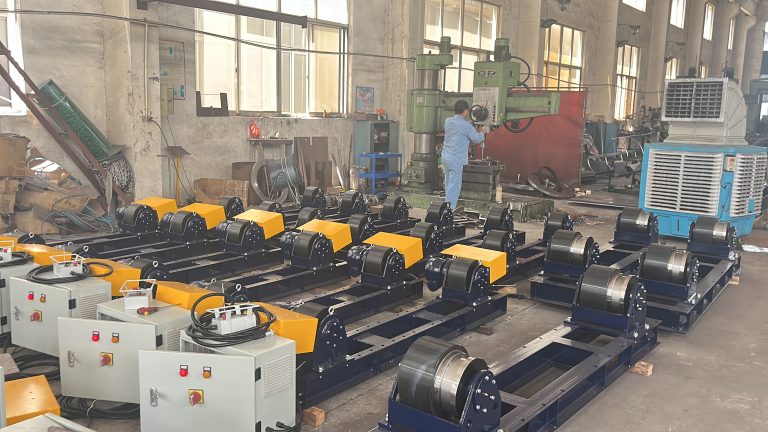
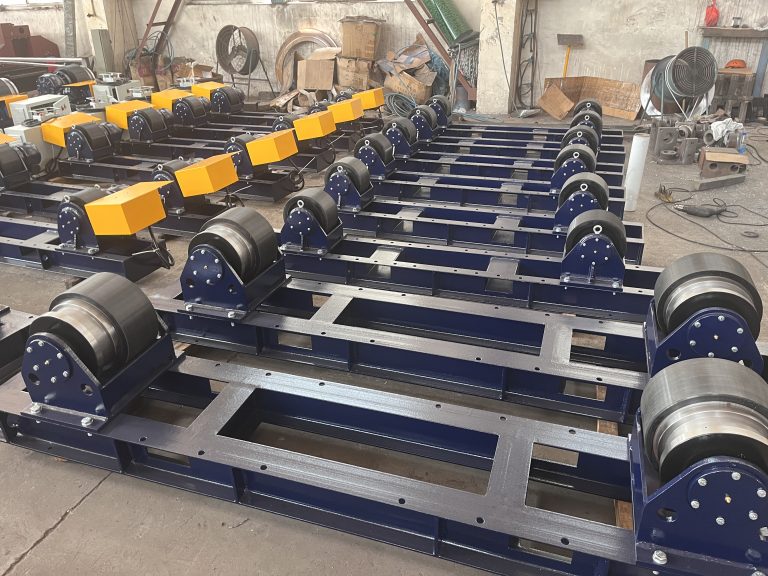
- In-House OEM: Full Cell A configuration + Digital Twin + Machine Vision QI + comprehensive documentation supporting own quality + brand
- Outsourced Contract Manufacturer: Fabricator invests in Cell A configuration + serves multiple OEM customers + specialty fabrication capability
- Toll Fabricator: Fabricator invests in Cell A configuration + performs fabrication service on OEM-supplied material + material handling + traceability system
Real-World Strategy Examples
- Oil major (Chevron/Shell/BP): Design in-house + fabrication typically outsourced to specialist EPC/fabricator; retains design + specification control
- Chinese fabricator (large domestic + growing export): In-house fabrication with Cell A configuration + serves both own-brand + contract manufacturing for international OEMs
- Middle East end-user (Saudi Aramco/ADNOC): Some in-house strategic capability + majority outsourced to local + international EPCs
- European specialty OEM (Alfa Laval + Sulzer): Own design + IP + selective in-house fabrication + significant outsourced global fabrication network
Trade-Off Insights
- In-house yields 8-15% lower per-unit cost at high utilization but loses 20-40% cost efficiency at low utilization due to fixed cost burden
- Outsourced adds 10-18% cost premium at high volume but scales elastically at 15-25% lower cost at low volume
- Toll fabrication typically 5-10% cost saving vs full outsourced when OEM has favorable material procurement + inventory management
- Hybrid strategies capture 60-80% of benefits of both in-house + outsourced pure strategies
Summary
In-House Fabrication vs Outsourced Contract Manufacturing vs Toll Fabrication make-vs-buy decision matrix for pressure vessel + heat exchanger + storage tank production — 3 strategies compared across capital investment + margin retention + capacity flexibility + technology control + supply chain risk + best-fit application. Cost comparison at 200 vessels/year: In-House 35,000 USD/vessel (7M USD/year); Outsourced 38.5-41.5k (7.7-8.3M); Toll 36.5-38.5k (7.3-7.7M). 6-question decision framework (volume + IP + capital + geography + material control + risk tolerance). Hybrid strategies common (core in-house + overflow outsourced; regional split; specialty vs commodity split; design in-house + fabrication outsourced). Wuxi ABK equipment fits all strategies (In-House OEM + Outsourced Contract Manufacturer + Toll Fabricator). Real-world examples: oil major design in-house + fabrication outsourced; Chinese fabricator in-house + contract manufacturing for international; Middle East end-user outsourced to EPC; European specialty OEM own design + outsourced network. Trade-offs: in-house 8-15% lower cost at high utilization but 20-40% penalty at low utilization; outsourced 10-18% premium at high volume + 15-25% lower at low volume; hybrid captures 60-80% of benefits. Wuxi ABK Machinery equipment Cell A configuration + Digital Twin + Machine Vision QI serves in-house OEM + outsourced contract manufacturer + toll fabricator across all three make-vs-buy strategies globally.
Related articles: TCO 5-yr vs 10-yr (Batch 35 #2); Financing 5-choice (Batch 36 #2); Process selection (Batch 37 #2); M&A + Strategic Partnership (Batch 34 #6); Emerging Market Entry (Batch 33 #6).
Contact: jan@weldc.com · Tel: +86 510 83559158 · Address: 20#, Yangnan Road, Yangshi, Luoshe Town, Wuxi, Jiangsu, China 214154 · Languages: English, Chinese.
Last updated: 2026-07-22.